Brain Stacking Ideas for India: Swap Doomscrolling for a Desi Stack
You open Instagram to check one message. Forty minutes later you know a stranger’s skincare shelf by heart and you have forgotten what the message was. If that sounds familiar, you are exactly who the internet’s newest wellness habit is for. It is called brain stacking, and the brain stacking ideas doing the rounds on TikTok and Reels are almost comically low-tech: a book, a puzzle, a notebook, kept in a little pile you reach for instead of your phone.
Most of the stacks you will see online are built for an American bedroom, with imported puzzle books and very expensive pens. So we built a version for India: what goes in it, what to skip, and how to make it stick when your phone is also your bank, your office and your family WhatsApp group.
What is brain stacking, really?
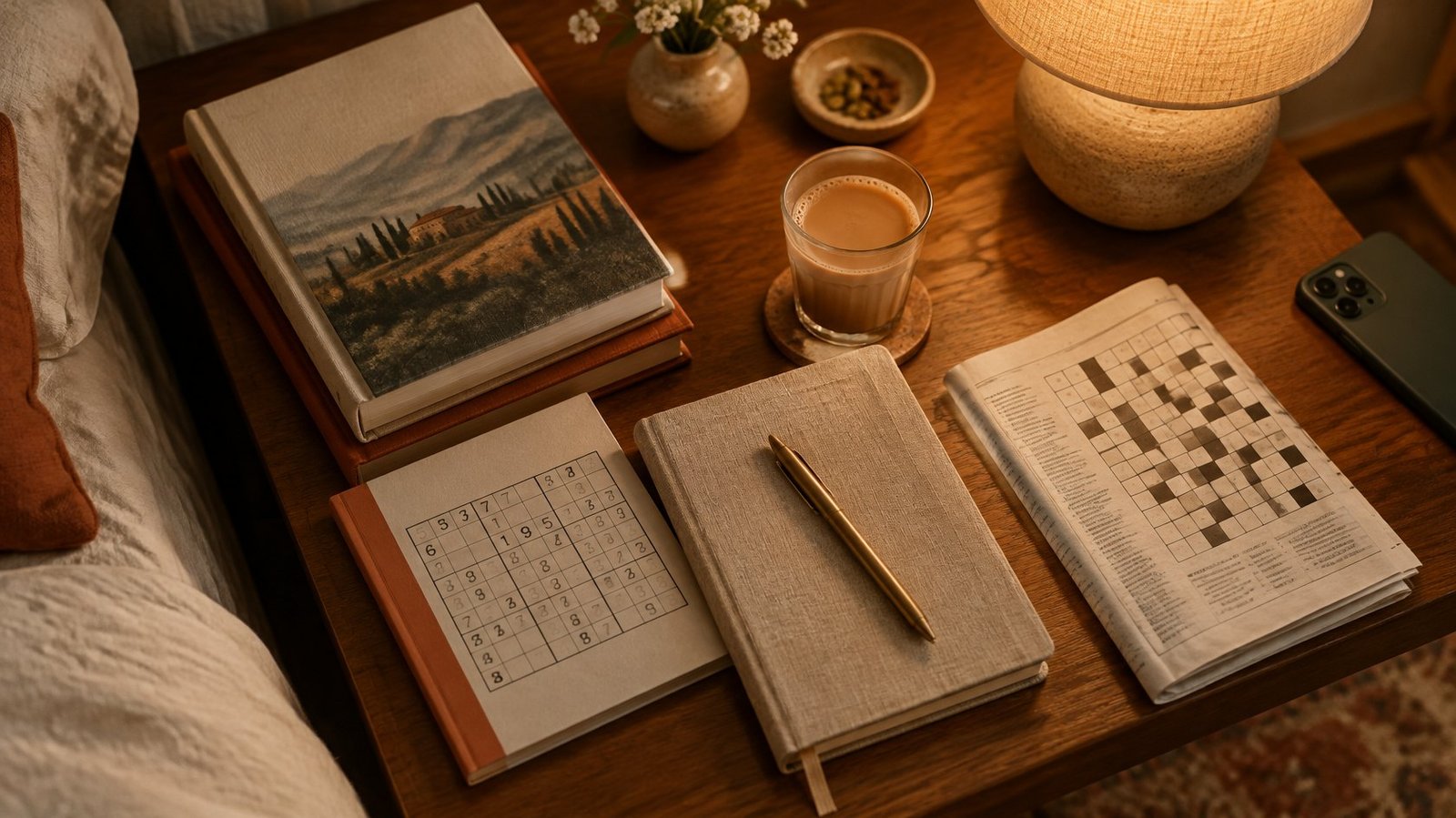
Strip away the aesthetic videos and the idea is simple. A brain stack is a small, physical collection of offline activities that make you think: a novel, a Sudoku book, a journal, a crossword, a sketchpad. You keep it within arm’s reach, usually by the bed or the sofa, and when the urge to scroll hits, you pick something from the pile instead. India Today, which covered the trend earlier this month, credits creators such as Mandy Rulez with popularising it, and notes that some routines run to around 45 minutes, though nobody is checking.
It sits inside a much bigger mood. Dazed reported this week that “getting offline” has become the wellness flex of 2026, pointing out that searches for Brick, a physical gadget that locks distracting apps, rose 250 per cent over the past year, and that a survey by the app publisher Rocapine found cutting screen time ranked above quitting smoking and drinking less among Americans’ wellness goals. There is even an app called Steppin that makes you walk to earn screen time, by default asking for 100 steps for every minute of screen time. When people are paying to be kept away from their own phones, a free pile of books starts to look rather smart.
Does it actually do anything?
Some of the claims online are inflated. You will see creators suggesting a stack of puzzles can ward off dementia, and that is not something a Sudoku book can promise. Neuroscientist Dr Elena Gross, speaking to The Tab, pointed out that brain health also depends on sleep, nutrition, exercise and genetics, not just mental workouts.
What she did back is more modest and more useful. Doing one thing without interruptions lets your attention settle in a way that a feed never allows. And swapping evening scrolling for a paper book or a journal also means less bright screen light before bed, which, she explained, can delay melatonin and make it harder to fall asleep. Her best tip was active recall: finish a chapter, close the book, and explain what you just read in your own words. That small act of retrieval does more for memory than rereading.
She also offered a warning we liked: do not turn every moment of rest into another productivity exercise. A brain stack that becomes a 45-minute self-improvement shift is just doomscrolling’s anxious cousin.
Brain stacking ideas for India: build your own stack
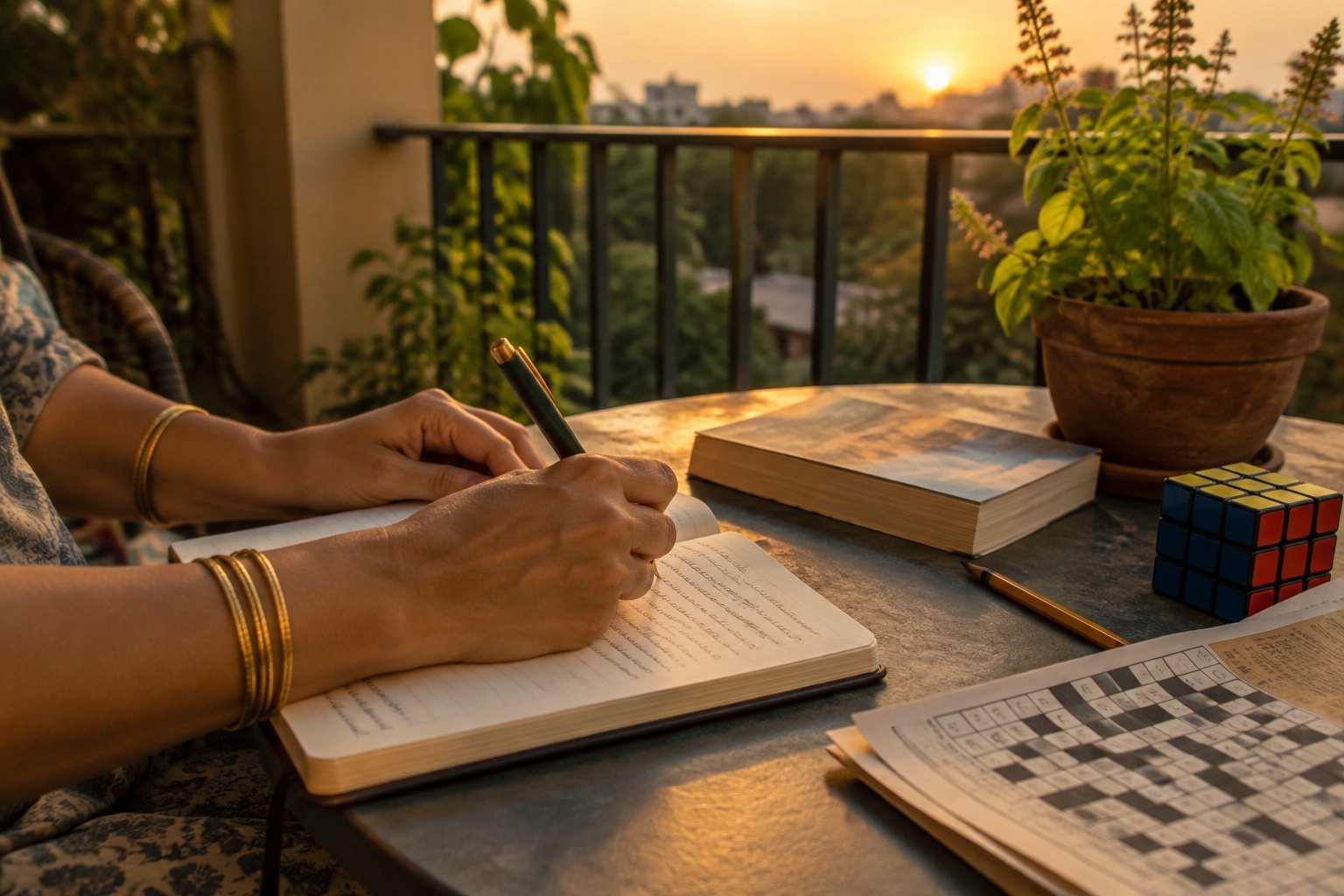
Think of your stack in three layers: one thing that challenges you, one thing that calms you and one thing that is pure pleasure. Pick one from each and you are done. Here is a pool to choose from, most of which you probably already own.
- The newspaper puzzle page. The daily crossword and Sudoku in your morning paper are the original brain stack, and they cost nothing extra. Tear the page out and keep it with your stack so it never ends up under the raddi pile.
- A crossword in your mother tongue. Hindi papers run a varg paheli, and most regional dailies carry their own word puzzles. Solving in a language you speak but rarely read is a proper workout, and a lovely way to stay close to it.
- A book you have half-finished. Not a new purchase. The novel with the bookmark stuck at page 80 is already waiting. Read one chapter, then try Dr Gross’s recall trick.
- A plain notebook. A thin school-style notebook from the stationery shop works as well as any designer journal. Write one line a night: what happened, what annoyed you, what you want tomorrow.
- Something for your hands. Crochet, knitting, a sketchbook, or practising your handwriting in Devanagari, Tamil or whichever script you learnt as a child. Hand-brain tasks are oddly calming.
- A chess puzzle book or a Rubik’s cube. Good for people who find journaling a bit too earnest.
- A deck of cards. Solitaire on actual cards is slower, quieter and somehow more satisfying than the app.
How to make it stick when your phone runs your life
Here is the honest problem with going analogue in India. Your phone pays the sabziwala, gets you the cab, holds your boarding pass and carries every family announcement. You cannot throw it in a drawer for a week. The trick is to make the stack easier to reach than the phone at the two moments you scroll most: the first half hour after you wake up and the last half hour before sleep.
- Move the charger, not the willpower. Charge your phone outside the bedroom or across the room, and put the stack where the phone used to be.
- Use the tools already on your phone. Android’s Digital Wellbeing has a Bedtime mode that greys out the screen and silences notifications, and iPhones have Downtime inside Screen Time. Set either to start when you want the stack to take over.
- Start absurdly small. Dr Gross suggested one page instead of an hour, one sentence instead of 20 minutes of journaling. Small wins are what bring you back the next night.
- Keep it visible. A stack that lives in a cupboard is a stack you will forget. Put it on the bedside table, the dining table or next to the sofa remote.
- Do not photograph it every night. Posting your stack is fine once. Turning it into daily content brings you straight back to the app you were escaping.
If you share a home with family, rope them in. A crossword solved by two people over chai counts. So does a game of cards with your parents after dinner. Indian households were brain stacking long before TikTok gave it a name; we just used to call it timepass.
What you do not need to buy
Every wellness trend eventually becomes a shopping list, and brain stacking is already heading there: matching journals, aesthetic puzzle books, candles, pens that cost more than a month of OTT. None of it is required. The same goes for gadgets. Physical app blockers like Brick have a real fan base, but you can test the habit for free first. If one week with a book and a notebook does not change your evenings, a device is unlikely to fix it for you. We had a similar thought about beauty advent calendars: pretty packaging is not the same as value.
And if your teenager is the one glued to Reels, a stack on their desk works better than a lecture. Pair it with the app-level controls, too. Our guide to Instagram’s teen accounts and Meta’s AI age check explains how those settings work in India.
Our take
Brain stacking is not new, and that is its best quality. It is a crossword, a novel and a notebook dressed up in a hashtag, and the hashtag is doing a useful job: making an old, boring habit feel worth trying again. Will a pile of puzzles rewire your brain? Probably not on its own. Will it win back a chunk of your evening from the algorithm? Quite possibly. Build it from what you already own, keep it to three things, put it where your phone usually sleeps, and give it two weeks before you judge it. The worst outcome is that you finally finish that book.
FAQs
What should I put in a brain stack?
Three things is plenty: something challenging (a crossword, Sudoku or chess puzzle), something calming (a journal, sketchbook or crochet) and something you simply enjoy (a novel or magazine). Mix and match until you find a combination you actually reach for.
How long should brain stacking take every day?
There is no rule. Some creators spend around 45 minutes, but starting with five or ten minutes before bed, or a single page or puzzle, is more realistic and easier to keep up.
Can brain stacking prevent dementia?
No single habit can promise that. Experts say mentally engaging activities may support brain health, but sleep, diet, exercise, heart health and genetics matter too. Treat brain stacking as a better way to spend screen time, not as a medical fix.