Gemini Glasses in India: Wait for Google or Buy Ray-Ban Meta?
Google finally has smart glasses you might actually want to wear. The question everyone in India is typing into search this week is simpler, though: can you get Gemini glasses in India, and if not, should you wait for them or just buy a Ray-Ban Meta pair that is already in stores here? We read Google’s launch notes, the fine print and the early coverage so you don’t have to. Short version: don’t import them, and don’t panic-buy anything either.
What Google actually launched
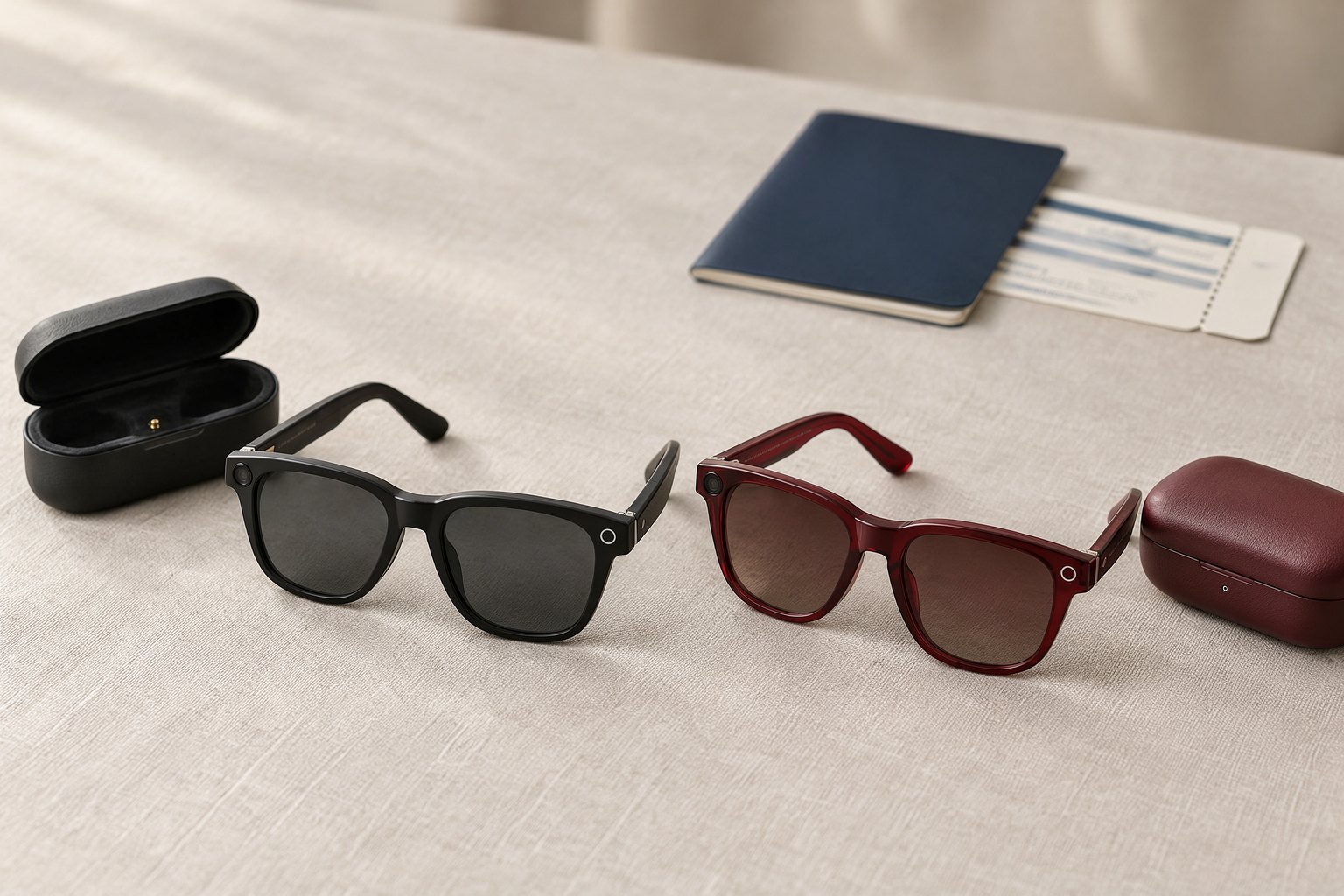
On 12 November, Google opened pre-orders for what it calls “intelligent eyewear”, built with Samsung on the hardware side and two eyewear brands on the design side. According to Google’s own blog post, Gentle Monster has six frames in loud colours like dark red, pink, grey and yellow, starting at $449. Warby Parker has three quieter styles, Alden, Reid and Wren, starting at $395 in Pine, Saddle and Jet Black. Sales and shipping begin on 10 December.
There is no screen in the lenses. You talk to Gemini by saying “Hey Gemini” or tapping the frame, and it talks back through small open-ear speakers. A 12-megapixel ultra-wide camera lets it see what you see, so you can look at a poster and ask it to check your calendar, or glance at a bookshelf and ask what to read next. Google Maps gives turn-by-turn directions in your ear, and Google says Translate can handle real-time speech translation across more than 70 languages.
The numbers that matter for daily wear: about 41 grams for the frame, up to nine hours of battery, and a charging case that refills the glasses up to seven times, all per Google. The Hindu reports the chip inside is Qualcomm’s Snapdragon AR1 Gen 1.
Can you use Gemini glasses in India right now?
No, and this is the part most launch stories skim past. Google’s footnote is clear: the glasses only work with Google accounts from the United States and South Korea, and the account has to belong to someone 18 or older. Business Standard and The Hindu both note that Google has not announced an India launch.
So the “my cousin in New Jersey can courier a pair” plan has a real problem. Even if the frames reach you, an Indian Google account isn’t on the supported list. You would be paying a premium for a pair of nice-looking glasses with a dormant assistant inside, and you would have no local warranty if a hinge or battery gives up. Ars Technica also points out that Warby Parker is selling only in the US, while Gentle Monster covers the US and South Korea.
Phone support is narrow too. Google lists the Pixel 7 series and newer, Samsung Galaxy S and Z series phones on One UI 9 or later, and iPhone 13 Pro or newer. Millions of Indians on Redmi, Vivo, Oppo, OnePlus or budget Samsung phones are simply not invited to this party yet.
What would they cost in India?
Nobody knows, and anyone quoting an “India price” right now is guessing. A straight conversion of $395 lands at roughly ₹35,000, which is also the figure Business Today’s Hindi site used. That ignores import duty, GST, lens upgrades and whatever local pricing strategy Google picks. Ars Technica notes that the US starting prices are for non-prescription lenses, so power lenses will push the bill higher. Treat ₹35,000 as a mood, not a quote.
Gemini glasses vs Ray-Ban Meta: the honest comparison
On paper, these two are closer than the marketing suggests. Both have a 12MP camera, open-ear audio, no display and an AI assistant you talk to. Here is how they stack up for an Indian buyer today.
- Availability: Ray-Ban Meta is on sale in India now. Gemini glasses are US and South Korea only.
- Price in India: Meta’s India store lists Ray-Ban Meta Gen 3 from ₹44,300, Gen 2 from ₹39,900 and Gen 1 from ₹22,400. Oakley Meta HSTN starts at ₹41,800. Google has no India price.
- Battery: Both claim up to nine hours on the newest models. Meta says the Gen 3 case adds about 50 hours; Google says its case recharges the glasses up to seven times.
- Assistant: Gemini plugs into Gmail, Calendar, Maps and the rest of your Google life. Meta AI leans towards WhatsApp, Instagram and music apps.
- Style: Ray-Ban gives you the Wayfarer, the Aviator and friends. Gentle Monster gives you the louder, more fashion-forward frames that Seoul street style made famous.
Where Google is trying hardest to stand apart is privacy. Its blog says camera visuals from Gemini on glasses are not saved to your Gemini history and are not used to train models or target ads, and that bystanders’ faces are automatically blurred before Gemini processes an image. A recording light switches on when you capture photos or video, and the glasses are designed to stop recording if that light is covered. Ars Technica adds two details worth knowing: Google won’t allow apps that live-stream video from the glasses to social media, and real-time facial recognition is off the table. Ars also notes that data is encrypted on the glasses and in transit, but not on Google’s servers.
That matters in India, where people are rightly touchy about being filmed in metros, gyms and weddings. We wrote about the same tension when Apple added Live Rewind on the Apple Watch: the tech is clever, the etiquette hasn’t caught up.
Is there a Gemini option in India today?
Sort of. Times of India’s Gadgets Now lists B by Lenskart at around ₹22,000, a pair that uses Google’s Gemini for voice help, takes prescriptions from -6 to +6 and has a 12MP camera. It is not Google’s own hardware and its quoted battery life is about four hours, so think of it as a different, more budget-minded product rather than an Indian version of the new glasses. If Gemini is the assistant you already use on your phone, it is worth trying on at a Lenskart store before you decide.
And if you mostly want Gemini in your ear on the move, your phone already does a lot of this. Our guide to using Gemini in the car in Hindi shows how far voice-first Gemini has come without a single new gadget.
Our take: wait or buy?
Buy Ray-Ban Meta now only if you already know exactly why you want camera glasses. Travel vloggers, cyclists who want hands-free clips, parents who want to film the kid without a phone in the way: you have a real, supported, locally serviced product today, and the Gen 2 at ₹39,900 is the sensible pick over the Gen 3 unless battery is everything.
Everyone else should wait. Google’s glasses look genuinely good, the Gentle Monster frames are the first smart glasses that read as fashion first, and the privacy rules are stricter than anything else on the market. But Ars Technica’s own testing note is a fair warning that Gemini still fumbles simple tasks, and without a screen you can’t always check its work. Give the first wave of US owners a few months to find the bugs. If Google does bring these to India, the version worth your ₹35,000-plus is one with Indian account support, a local warranty and proper lens partners, and ideally a Gemini that handles Hindi well in your ear.
Importing is the one choice we would rule out completely. Until Google switches on Indian accounts, it is a very expensive way to own regular glasses.
FAQ
Are Gemini glasses available in India?
Not yet. Google’s intelligent eyewear goes on sale on 10 December in the United States and South Korea, and Google says it only works with Google accounts from those two countries. There is no India launch date.
What is the Gemini glasses price in India?
There is no official Indian price. US prices start at $395 for Warby Parker frames and $449 for Gentle Monster frames, which converts to roughly ₹35,000 and up before duties, taxes and prescription lenses.
Which smart glasses can I buy in India right now?
Ray-Ban Meta Gen 3 (from ₹44,300), Gen 2 (from ₹39,900) and Oakley Meta HSTN (from ₹41,800) are sold officially through Meta’s India store. B by Lenskart, at around ₹22,000, uses Gemini for voice help.