How to Wear Farshi Salwar: The Bigg Boss 20 Trend, Decoded
Every few seasons, a television show does what a fashion week can’t. This time it’s Bigg Boss 20, and the garment is the farshi salwar, the floor-sweeping trouser that used to live in old Awadhi portraits and Eid lookbooks. If you’ve watched Uditi Singh or Arishfa Khan glide across the house and wondered how to wear farshi salwar at a real wedding, on real stairs, in a Delhi winter, this is the practical version. No courtly fantasy required.
Why the farshi salwar is suddenly everywhere
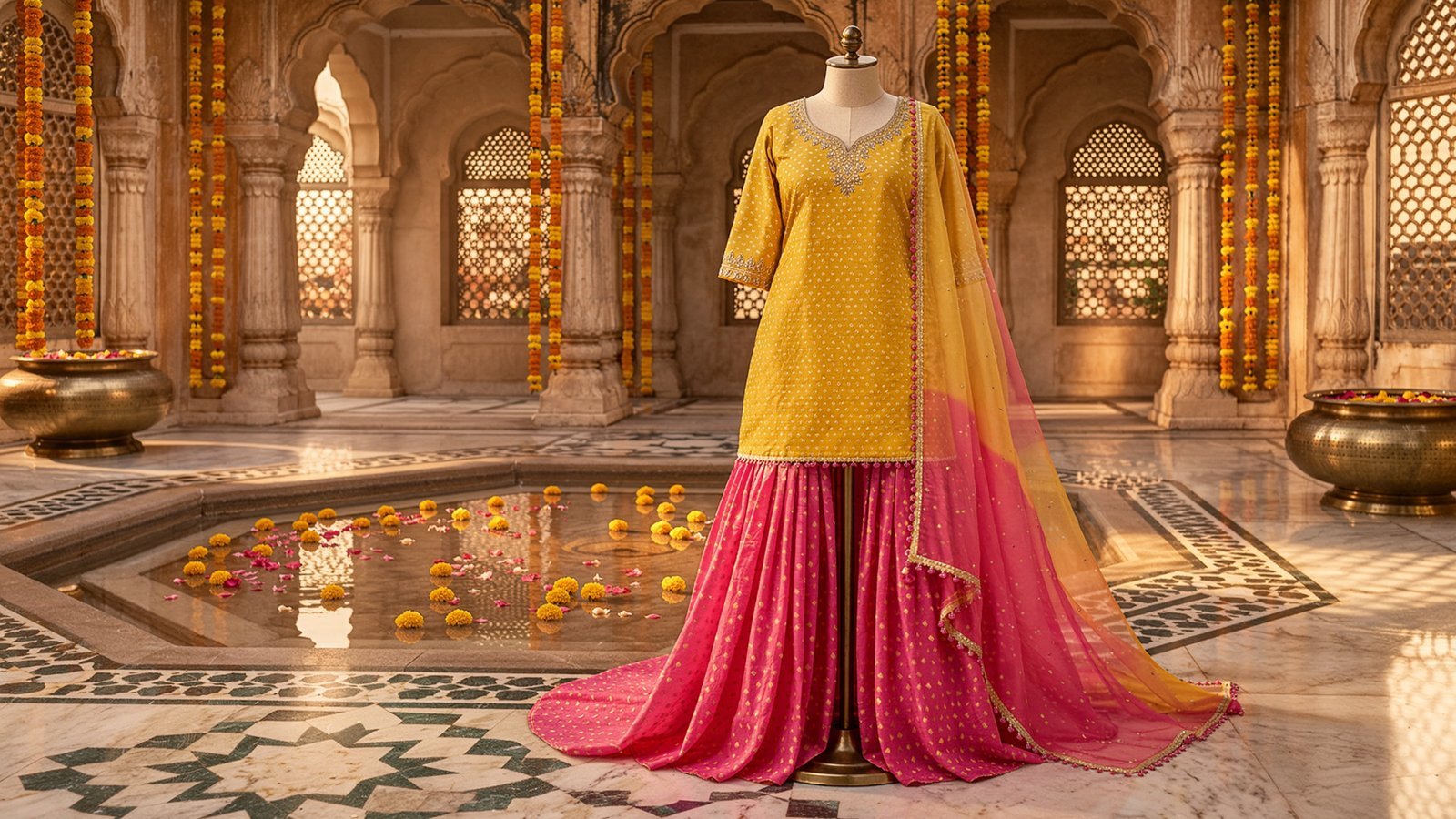
Siasat traced the spike in a piece published on 21 November: Uditi Singh wore a sunshine-yellow and pink bandhej farshi set, Arishfa Khan a floral print in green and purple, both during Weekend Ka Vaar episodes, and fan pages on Instagram and X went straight to work identifying colours and recreating the looks. Search behaviour backs it up. Type “farshi salwar” into Google and the suggestions are almost entirely shopping queries: suits under ₹1,000, cotton sets, Meesho listings, versions with dupatta.
The silhouette itself is old. The name comes from farsh, the Persian and Urdu word for floor, and Harper’s Bazaar India has written about its roots in 18th-century aristocratic dressing in present-day Uttar Pradesh. It never fully disappeared. It survived in bridal trousseaus, dance costumes and, more recently, Pakistani designer collections from labels like Hussain Rehar and Zara Shahjahan, which is a big part of why it returned to Indian moodboards around Eid 2025.
What’s different now is the price point. A trend that used to mean a custom piece from a tailor has hit mass-market ethnic platforms within days.
Farshi vs sharara vs gharara: the 10-second test
Half the listings online use these names interchangeably, so check the cut, not the label.
- Farshi salwar: full volume from the waist, no knee seam, and enough length that the hem touches or pools on the floor. Length is the whole point.
- Sharara: wide, flared legs from the waist or hip, but cut to ankle or just below. It moves like a skirt and doesn’t drag.
- Gharara: fitted to the knee, then a visible joint (often covered with gota) and a gathered flare below.
If a product photo shows the model’s feet clearly, it’s probably a sharara with a farshi tag. A real farshi hides the shoes.
How to wear farshi salwar without tripping over it
This is where the reels skip a few steps. A trouser designed to touch the floor is gorgeous on a set with flat, swept floors. A shaadi venue with lawn grass, banquet stairs and a dance floor is a different matter. Here’s what actually makes it work.
Keep the kurta short
The drama lives below the hip, so let people see it. A hip-length or mid-thigh kurta gives you that strong contrast between a neat top half and a full bottom half. Go knee-length or longer and the volume disappears into a shapeless column. The Bigg Boss looks get this right: short kurtas, lots of salwar.
Hem it to your shoes, not your height
Decide on your footwear first, then get the length set while you’re wearing it. For most people that means a hem that just grazes the floor at the back and clears the toe at the front. A deliberate little pool looks lovely in photos but is a liability anywhere with steps. Ask your tailor for a slightly shorter front hem; it’s a small fix that saves a fall.
Pick block heels or padded juttis
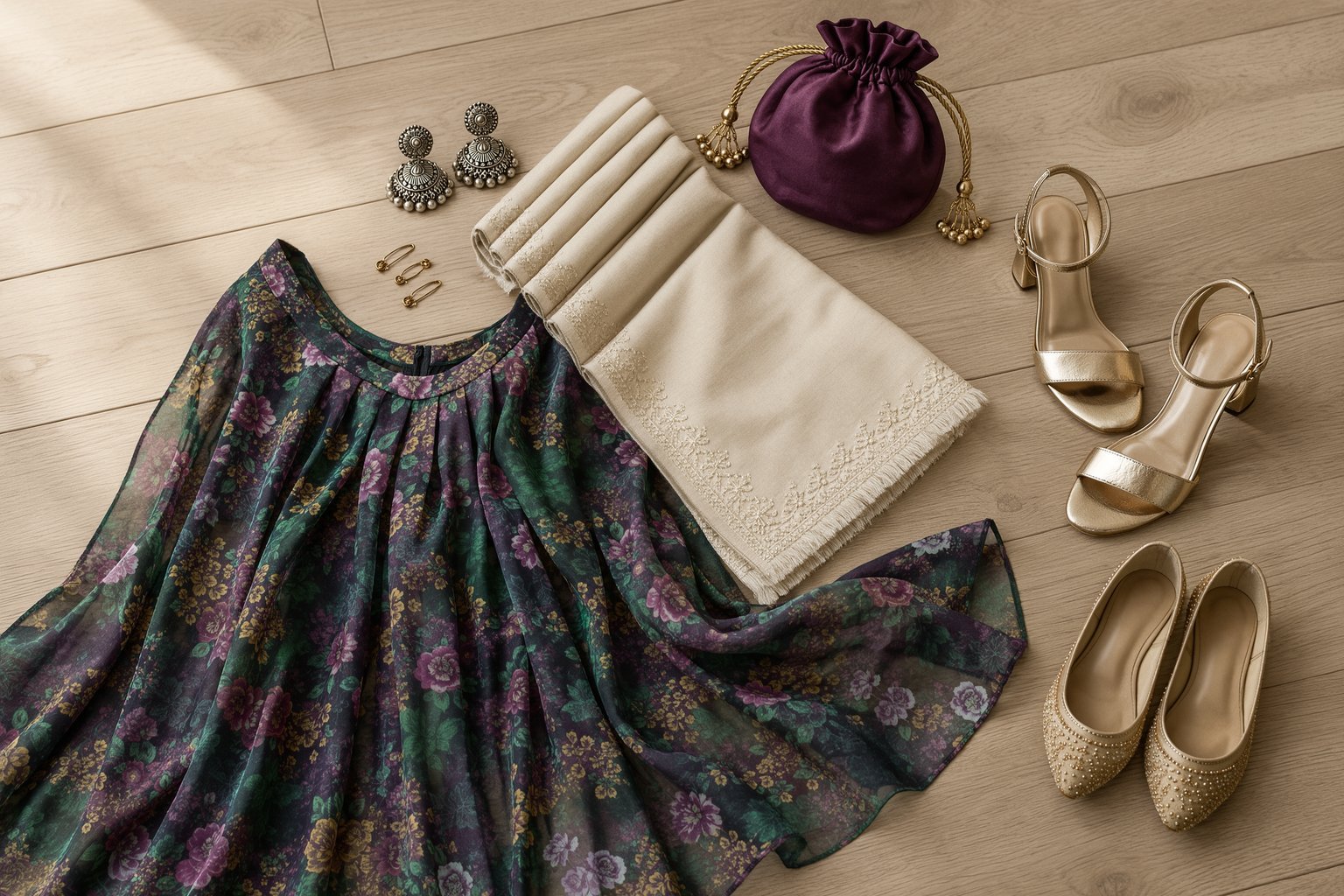
Stilettos sink into lawns and catch in the gathers. Flat juttis can make the fabric drag more. Block heels, wedges or juttis with a slight lift give you height without the wobble. Embroidered juttis suit the traditional sets; gold strappy block heels look sharper with solid colours.
One statement only
With this much fabric already doing the work, choose one loud element: heavy jhumkas, an embroidered dupatta, or a print like bandhej. Not all three. Tonal sets in sage, blush or powder blue look expensive precisely because nothing competes.
Pin the dupatta
Over one shoulder and pinned at the shoulder and waist keeps your hands free for plates, phones and the bhangra circle. If the dupatta has a heavy border, a front drape across the chest works for sangeet nights, as long as it’s secured.
Wearing it in a North Indian winter
Most farshi sets you’ll see online are breezy cotton, georgette or chiffon, because that’s what photographs well. For December weddings in Delhi, Lucknow or Jaipur, you’ll want a little more weight. Velvet or silk kurtas over a georgette farshi, a pashmina or embroidered shawl thrown over one shoulder, or a short velvet jacket instead of a dupatta all work. Siasat notes the contestants have paired theirs with shawls too, and it’s the easiest winter fix. Keep the layer cropped or fluid; a long coat will flatten the volume you paid for.
Is the cheap version worth buying?
According to Siasat, designer farshi pieces with hand embroidery can run from ₹15,000 to ₹60,000 and more, while ready-to-wear printed cotton, light georgette and bandhej sets on platforms such as Myntra and Meesho sit roughly between ₹1,500 and ₹4,500. Listings well below that exist too, and that’s where buyers get burnt.
Before you order, check three things:
- Fabric weight: thin, see-through georgette won’t hold the fall and will cling. Look for “lined” or “with inner” in the description.
- Actual length in inches: a farshi should be at least as long as your waist-to-floor measurement, ideally with extra. If the listing doesn’t say, assume it’s a sharara.
- Return policy: volume is hard to judge from photos. Only buy where returns are simple.
Our take
The farshi salwar is the rare TV trend that deserves to outlive the season, because it isn’t a gimmick. It’s a heritage cut that photographs beautifully and feels softer than a lehenga at a mehendi or a day wedding. But it rewards planning. Buy a properly lined set, fix the hem to your shoes, and keep the kurta short. If you want the look for one evening and hate fuss, a well-cut sharara gets you most of the drama with none of the stair anxiety. If you want the moment when the fabric sweeps behind you on the dance floor, go full farshi.
Still planning wedding outfits? Our guide to Kate Middleton’s red anarkali and how to get the look in India covers another silhouette having a big moment, and if the invites are piling up, here’s how much shagun to give at a wedding.
FAQ
Can short women wear a farshi salwar?
Yes. Keep the kurta short (hip-length works best), choose a single colour for kurta and salwar so the line looks longer, and add a block heel. Avoid very heavy fabrics that add bulk at the hem.
What should I wear on top of a farshi salwar?
A short or mid-thigh kurta, a peplum, or a short angrakha. In winter, a cropped velvet jacket or a shawl over one shoulder keeps you warm without hiding the flare.
Is a farshi salwar the same as a sharara?
No. A sharara is wide but usually ends around the ankle. A farshi salwar is cut long enough to touch or pool on the floor, which is what gives it its name and its sweep.